
Speaker:
- Anahí Farji Neer
Fellow MIAS - François Chevalier
Casa de Velázquez
The seminar will also be accessible online.
Thank you for filling out the form to obtain the access link.
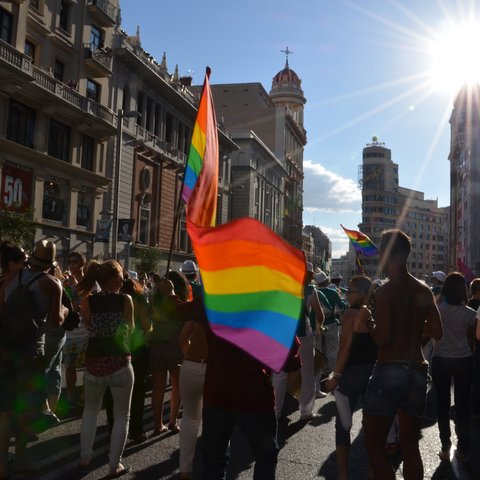
Fig: Manifestación Estatal Orgullo LGTB 2012. Source: Wikimedia Commons.
The field of healthcare has historically constituted an arena of contestation over the social meanings attributed to people who identify with a gender different from the one assigned to them at birth. Biomedical discourse has produced the main pathologizing meanings associated with trans people. In recent decades, trans activism, regulations recognizing the right to gender identity, and artistic and media productions have challenged these meanings. In this context, the healthcare field has consolidated its ambivalent character as a domain in which pathologizing practices coexist with forms of listening, support, and care that support trans people in pursuing their desires and life projects.
The seminar explores how trans people’s access to healthcare is shaped by the meanings and practices that emerge within healthcare institutions, as well as by their geographical location. The spatial dimension of access to healthcare encompasses both the possibilities offered by different healthcare facilities distributed across a given area to provide respectful and technically appropriate care, and the ways in which people move through that space and the meanings trans people construct around it.
Taking a comparative perspective on the Buenos Aires Metropolitan Area and the city of Madrid, the seminar explores how uses of urban space shape trans people’s access to healthcare. In particular, it addresses conflicts surrounding the definition of moral boundaries governing the movement of bodies that challenge gender norms through public space, and examines how these conflicts intersect with the circulation of health-related knowledge and care strategies among trans people.