
Speaker:
- Élodie Bordat-Chauvin
Fellow MIAS - SMI CNRS
Casa de Velázquez
The seminar will also be accessible online.
Thank you for filling out the form to obtain the access link.
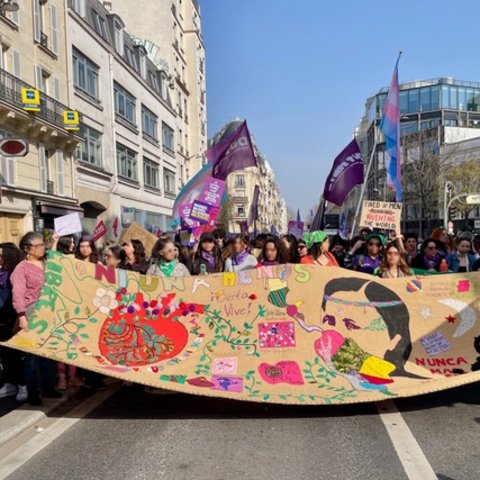
Fig.: “BloK Mujeres & disidencias Abya Yala” at the March 8, 2026 demonstration in Paris. Source: Photograph by Elodie Bordat-Chauvin. Paris, France.
On November 23, 2024, around fifty feminists rehearse “Le violeur, c’est toi”—the French adaptation of LasTesis’ 2019 performance “Un violador en tu camino” (“A Rapist in Your Path”)—and “Canción sin miedo” (“Song Without Fear”), in which Vivir Quintana denounces femicides in Mexico. They are preparing for a demonstration against violence against women, as the trial of Gisèle Pelicot’s rapists is underway. This performance and song, along with the green scarf associated with Argentina’s struggle for legal abortion, have become part of the “repertoire of contention” (Tilly, 2018) of numerous feminist collectives in France and Spain.
Who explains, translates, and adapts these songs and symbols so that they resonate with European feminist activists? What are the trajectories of these intermediaries, or passeuses (Jobard et al., 2020), involved in this transnational circulation? What emotions do they evoke in the activists who use them and in the audiences who observe them during demonstrations (Jasper, 2018)? And what concepts and narratives circulate alongside these songs and symbols?
To address these questions, I am conducting (n)ethnographic research (Despontin Lefèvre, 2022) with anti-racist feminist groups in Paris and Madrid.