
Speaker:
- Claire Bouvier Sorel
Fellow MIAS - SMI CNRS
Casa de Velázquez
The seminar will also be accessible online.
Thank you for filling out the form to obtain the access link.
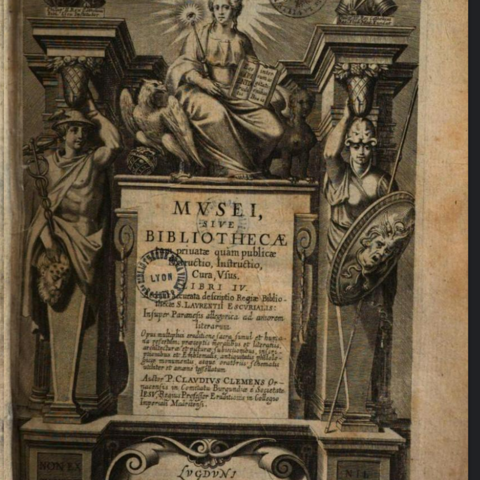
Fig: Claudio Clemente, Musei sive Bibliothecae, Lugduni, Sumptibus Iacobi Prost, 1635. Source: Google Books.
How were books made in the Early Modern Period? Who decided what was published, how was their production organised, and how far could books travel?
This lecture presents research into the printed output of the Imperial College of Madrid between 1603 and 1700. Run by the Society of Jesus and closely linked to the House of Habsburg, the College was one of the leading educational and cultural institutions of the Madrid court during the seventeenth century. It fostered intense intellectual activity, which gave rise to a highly diverse printed output, ranging from scholarly treatises, religious works and texts related to teaching to academic disputation theses and occasional writings, such as accounts of festivals and public ceremonies.
Taking as its starting point the Musei sive Bibliothecae, an important treatise on library science by the Jesuit Claude Clément, a professor at the Imperial College, the lecture examines the relationships between teaching, writing and printing in the context of the College. This case study makes it possible to explore how a text produced in an educational setting could become a book intended for readers in other territories, and how its publication was shaped both by its author's intellectual and religious aspirations and by political circumstances and the opportunities offered by the book trade.
Building on this case study, the lecture proposes an examination of the College's printed output that considers not only authors and their works, but also writing and publishing practices, the institution's internal workings, and its connections with the world of books. Studying this printed output thus makes it possible, through the example of the Imperial College of Madrid, to explore the relationships between the production of knowledge, publishing practices and the circulation of books in early modern Europe.